I’ve been obsessed with Italy’s sagre since my first introduction to them. So much more than food festivals (though food’s a big part of it), these are celebrations of a local community, culture and cuisine. The particular foodstuff they celebrate completely ranges — anything from white truffle to chocolate to pumpkins to chestnuts to wine. And the best season for them? The autumn! Which is why I just wrote about seven of the best sagre in Italy in autumn — from a little town just outside Rome to Puglia to Piedmont — for The Guardian. Check it out here.
Ah, Rome at Christmas! With the festive lights a-sparkling and families a-shopping, Christmas trees a-twinkling and nativity scenes a-…um, whatever nativity scenes do — well, it really is the most wonderful time of year.
Want to make the most of it? Here’s my complete guide to Rome at Christmas… and New Year, too.
Rome at Christmas basics: what will be open, what will be closed, and other burning questions
In the short video below, I answer some of readers’ biggest questions about visiting Rome at Christmas.
What to do when visiting Rome at Christmas and New Year’s
One beloved Christmas tradition in Rome: the Christmas market at Piazza Navona
Rome has lots of special events and activities over Christmas. Here are 9 festive experiences in Rome from the end of November to the beginning of January, from ice-skating to Christmas markets.
And speaking of Christmas markets… here are some of your best bets for the 2019-20 season.
One traditional Italian gift: a beautifully-wrapped panettone
Get off of Via del Corso (no, really, please get off Via del Corso), and you’ll find tons of hidden independent boutiques and artisanal workshops in Rome — great for finding the perfect gift.
Are you finding this post helpful? Then you’ll love The Revealed Rome Handbook: Tips and Tricks for Exploring the Eternal City,available for purchase on Amazon or through my site here and now updated for 2020!
One of the biggest Christmas traditions in Rome is la befana. She’s the figure you’ll see across Rome come the holidays — and with her hooked nose and broomstick, she’s often mistaken for a witch. Here’s what to know about la befana, and this super-sweet video, below, explores the tradition further.
If you’re going to be a guest of an Italian family for any holiday meals, or you want to cook (or eat) according to Italian tradition this Christmas yourself, don’t miss this post on how to have an Italian Christmas meal.
Italian food is super-regional. But at every bakery in Rome in Christmas, you will see pandoro (a golden cake originally from Verona), as well as panettone (from Milan). Don’t miss my BBC Travel story about what you don’t know about panettone.
Tastings of torrone, panpepato and panforte at the pandoro festival in Rome
Want to know about New Year’s? These are some of the main New Year’s traditions in Italy. (Yes, my Italian friends really insist on wearing red underwear. So much so a [female!] Roman friend once even gave me red underwear as a gift… just to be sure I would).
If you liked this post, you’ll love The Revealed Rome Handbook: Tips and Tricks for Exploring the Eternal City, available for purchase on Amazon or through my site here! I’m also free for one-on-one consulting sessions to help plan your Italy trip.
A fan of restorations that reveal art as it was meant to be seen? Me too. So I’m liking the “big reveal” that took place this fall at the Palazzo Quirinale, unveiling decorations by Cortona and his students for the first time in 200 years. For more, check out my latest In Transit post here. (Photo: Palazzo Quirinale press office).
1. See the Pope. Over the Christmas season, you’ve got lots of opportunities, from midnight mass (although getting tickets can be tricky) to “Urbi et Orbi” on Christmas Day (no tickets needed). Here’s more on how exactly to see the Pope throughout December and January.
Even if you aren’t in Rome at Christmas Day, you may get another chance to see the Pope!
2. Head to a Christmas market. They pop up all over Rome at Christmas. The most famous is, of course, that in Piazza Navona (both at top and below). Here’s a list of other Rome Christmas markets.
The famous Piazza Navona market, one of the most famous things to do in Rome at Christmas
4. Go ice-skating. Skate underneath the iconic silhouette of Rome’s Castel Sant’Angelo (to be confirmed for 2018 — check here). Other skating rinks in Rome include those at the Auditorium, Re di Roma, Tor di Quinto, and Villa Gordiani.
5. Delve into the tradition of Italian nativity scenes. As well as Christmas cribs popping up in churches all over town, Rome boasts both a museum of more than 3,000 of them and, over Christmas, an exhibition of 200 presepi from artists across the globe (now in its 41st year). Here’s my New York Times piece on where to find presepi in Rome. (The article’s old, but the information’s still good).
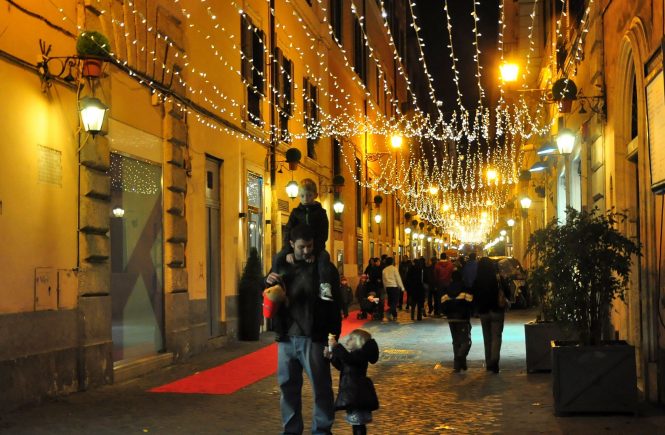
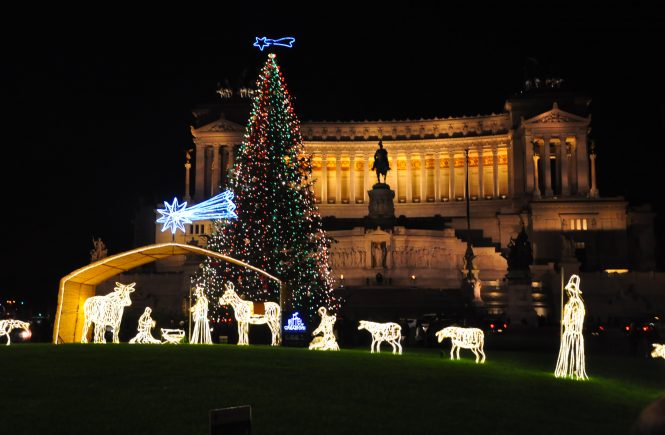
6. Check out the Christmas lights. Decorations are getting more ambitious every year, with gorgeous twinklings (and light projections, and jumbo screens) lighting up not only the heart of Rome’s centro storico, but even Termini, EUR, and the Fiumicino airport. Don’t believe me? Check out my photo post of the prettiest lights and decorations in Rome at Christmas!
9. Enjoy delicious Christmas sweets. Bakeries are brimming over with yummy holiday offerings like panettone, torrone and pandoro (above). If you’re in Rome at Christmas, make sure to taste the goods. It’s the one time of year that even Italians over-indulge in the sweet stuff!
If you liked this post, you’ll love The Revealed Rome Handbook: Tips and Tricks for Exploring the Eternal City, available for purchase on Amazon or through my site here! I’m also free for one-on-one consulting sessions to help plan your Italy trip.
Great news: Across Europe, museums will be free and open late the night of May 14.
Here in Rome, that includes all state-owned museums, like the Musei Capitolini, MACRO, Galleria Borghese, Palazzo Barberini, and Castel Sant’Angelo.
A little more unusually, it also includes museums not often part of these free events, like the Scuderie del Quirinale (currently with a Lorenzo Lotto exhibit); the MAXXI, with its great Michelangelo Pistoletto exhibit; and the Palazzo delle Esposizioni, with its show on European 19th- and 20th-century art including pieces by Corot, Monet, Renoir, Ernst, Klee, and Picasso.
All will be open, and free, from 8pm-2am, with last entrance at 1am.
Another bonus? The Palazzo dell Esposizione hosts two piano concerts by Michelangelo Carbonara, one at 9pm and one at 10:30pm, celebrating the same time period that’s also shown with the exhibit.
If you want to avoid the usual Sistine Chapel crowds, here's one way to do it: Go to the Vatican at night.
For the third year in a row, the Vatican museums are having their "extraordinary opening" from 7pm-11pm. Last year, more than 30,000 people took advantage. And whether your day is completely booked or you'd simply like to see the Sistine Chapel and Laocoön in a bit of a more serene atmosphere, now's your chance.
The museums will be open on Friday nights from now until July 15, and then again from Sep. 2 until Oct. 28. Last admission is at 9:30pm.
The areas open in the museums are the Egyptian museum, Pio-Clementine, Galleries of Tapestries, Candelabra, and Maps, Raphael Rooms, Borgia Apartment, Collection of Modern Religious Art, and, of course, the Sistine Chapel. (There's no guarantee, and it's in fact unlikely, that other areas, like the Pinacoteca, will be open).
Tickets must be booked in advance, so the full-price ticket is €19 (includes the €4 reservation fee), or €12 reduced (students, bring your I.D.s!). Click here to book.
Until Nov. 30, Cinecittà Studios — the former haunt of everyone from Federico Fellini to Audrey Hepburn, Elizabeth Taylor to Roberto Rossellini — are open for visitors as part of the show “Cinecittà Si Mostra.”
I checked this out on the opening day for a story for Global Post, and the show is definitely cool. It’s a neat chance to get a glimpse at the movie studio so legendary, it was called “Hollywood on the Tiber” — and that was the set for hundreds of movies, including Cleopatra, La Dolce Vita, War and Peace, Roman Holiday, Ben-Hur, and, more recently, Gangs of New York, Nine, Mission Impossible 3, and The Life Aquatic with Steve Zissou… to name a few.
In one building, an exhibit has been set up that walks you through the making of a movie, from the costumes to set design to post-production.
The downside? It’s in Italian, and not super-elaborate. The upside? The items that are included. The costumes: Elizabeth Taylor’s gold gown and intricate wig as Cleopatra, Sean Connery’s habit as a friar in The Name of the Rose, the papal vestments worn for this year’s Cannes-destined film Habemus Papum (latter two, shown above). The accessories (below): Pilot’s goggles from The English Patient, gladiator’s armor from the HBO/BBC series Rome. The items from past sets, including the dolphin-shaped statue that marked the chariot laps in Ben-Hur and the throne from Cleopatra. And sketches of the set design for previous movies.
In the second building — the Palazzina Fellini, dedicated by the studios to the great director — more costumes (my favorites: the glittering white dress that Audrey Hepburn wore in the War and Peace posters, and the slinky velvet dress and fur stole donned by Anita Ekberg for La Dolce Vita, shown at top). More photographs. And, in the theater of the Palazzina, a film showing. (All, however, in Italian).
The pièce de résistance of the exhibit, though, is the chance to peek at the sets themselves. A black Mercedes van scoops you up (at least, it was a Mercedes on the opening day!) and takes you through a street designed for Martin Scorsese’s Gangs of New Yorkbefore plopping you in what can be best described as a whacked-out version of ancient Rome, designed for the television series (below).
Here’s a Rome where, true to historical authenticity, the temples were colorfully painted, graffiti splotched monuments, and tenement buildings ran several stories tall. Here, too, is a Rome where those buildings are fiberglass, the other side of a major temple is the city wall, and behind graffiti-splotched walls are… nothing. Ah, the tricks of the movie business.
All in all, the show didn’t have quite as much to offer as I thought, in terms of sheer exhibit space and items (although the items that were shown, like the costumes, were pretty cool). The Italian-only signs and movies might be frustrating for English speakers. And even the set of ancient Rome could be a little disappointing: They say the set is 4 acres, but the part you’re actually allowed to explore seems to be much smaller.
Still, if you’re a movie buff or simply looking to do something a little different (or to walk through a version of ancient Rome, no matter how whacky it is), this is the place to come.
The Cinecittà Si Mostra exhibit runs until Nov. 30. Tickets cost €10; the studios, and exhibit entrance, are right at the Cinecittà metro stop (about a 25-minute ride from Termini). The exhibit is open daily from 10:30am-7:30pm, except Tuesdays (making it a good option on Monday, when all the other museums are closed!). And here’s my Global Post article, for more on Cinecittà and on Rome’s film industry.
Even crazier than the idea of a ginormous, gift-giving bunny is the fact that, on Easter, Rome actually keeps its museums and monuments open. Instead of closing them, which is usually par for the course on national holidays.
Like last year, therefore, you can look forward to lots of sites being open this Easter Sunday and Monday (including even those museums that would normally be closed Mondays). Sites open include the Colosseum, Borghese Gallery, Ara Pacis, Palazzo Massimo, Capitoline Museums, Palazzo Barberini, Galleria Corsini, and Castel Sant’Angelo (above). The exceptions: MACRO Testaccio and La Pelanda, which will remain closed.
Happy birthday to the world's most fascinating, historic, and beautiful city (yes, I'm biased): Rome! Tomorrow, April 21, marks the city's 2,764th birthday. (Although by now, who's counting?)
That means, of course, that Rome's going to celebrate in style. Including with free museum openings, shows, and other festivities.
At the top of our list of free, fun ways to celebrate Rome's 2,764th:
All day. Free museums. Rome's municipal museums are free, including great, off-the-beaten-path gems like the MACRO, Montemartini, and Ara Pacis. Here's a complete list of free museums on April 21 (in Italian).
9am. Ceremony with Rome's mayor, Gianni Alemanno. Rome's mayor lays a wreath at the Tomb of the Unknown Soldier at the Vittorio Emanuele monument, Piazza Venezia. Pomp and circumstance ensues.
11:30am. Concerts at the Campidoglio. Today it might be best known for Michelangelo's architecture, but back in the day, this hill was one of Rome's most sacred. Stop by for some music while the Granatieri of Sardinia look on.
11:30am. Reenactment of Rome's founding. At the Circus Maximus, the Gruppo Storico Romano performs the tale of Rome's 753 B.C. founding. Who will you root for: Romulus or Remus?
3:30pm. Inauguration of the "Bridge of Music." The bridge, in the Flaminio neighborhood near the MAXXI and other cultural gems, gets inaugurated to the sounds of the band of the metropolitan police corps.
4pm. Concert at the Capitoline museums. At 4pm, the Orazio Vecchi choir will give a free concert in the Pietro da Cortona room. Arrive early to get a seat.
6pm. Historical reenactment of Palilia. In front of the Bocca della Verità, the Gruppo Storico Romano will "perform" the pagan Palilia ceremony, a celebration of spring's arrival that Romulus himself was said to have participated in.
9pm. A "spettacolo" of light projections, performances and music. At 9pm at the Forum of Augustus (in the Imperial Forums), there'll be a show called "Roma/Amor, the birth and resurrection of the Eternal City," celebrating Rome from 753 B.C. right up until today.
From now until April 17, Italy’s state-run museums and sites are free. (Yay!) In Rome, that includes the Colosseum, Forum, Palazzo Massimo, Galleria Borghese (where you can find Raphael’s beautiful “Entombment,” above) and Baths of Caracalla… to name a few. Take advantage!




 before plopping you in what can be best described as a whacked-out version of ancient Rome, designed for the television series (below).


